

TL;DR
Q: How can you tell real GEO and AEO from a rebranded SEO shop?
A: Ask an agency what causes an AI citation. This will provide a real “tell.” AI citations come from retrievable pages, self-sufficient passages, and independent corroboration. Search engines rank whole pages, and answer engines select individual passages. A page can rank at the top of Google and still earn no AI citations. Any consultancy selling a schema trick is selling a loophole with an expiration date. Wrecking your SEO wrecks your AI visibility. A page can rank organically and still lose the linked citation. Brands can be mentioned frequently while their website is rarely cited. Search rankings and AI visibility require separate scoreboards. AIMCLEAR measures who gets named, linked, or shut out.
The AIO/AEO/GEO World is Full of Posers
Last week we had a new local services client reach out with a story all too common. A design firm charged them ~$14,000 for a decent WordPress site redo. Unfortunately, the design agency promised to build the site “SEO ready” with 60+ fully duplicate location pages, including typos copied page to page. Needless to say, in tandem with algorithm changes and generally declining search traffic, the business was crushed financially.
I told them that the world is replete with old world SEO relics that talk a good game and don’t have a clue what this generation of search and AI multi-surface visibility means or how to operate.
We’re (happily) deluged with inquiries about rescuing websites for brands of all sizes. It makes sense. Despite Google PR spin, it’s clear that they’ve broken the bond with webmasters, forged nearly 20 years ago and gradually depreciated. No longer can we expect, even as Google monetizes our IP, near the level of traffic even as Google silos visitors within the Google experience.
Unfortunately for posers, AIO (Google AI Overviews) and AEO (LLM/Answer engine optimization) is an emergent hybrid of science and art. Brands that work with poser marketing agencies and consultants who wreck SEO to earn AI visibility wreck both. This post is to support brands in determining if that shiny pitch deck from a repositioned SEO shop is a last-gen search playbook in new packaging.
First, AIO/AEO requires a huge amount of study. I founded AIMCLEAR, study, test, develop, and build more than 200 hours a month in addition to working with a few CMO relationships alongside our team.
Ask a potential AI-search agency to see their studies. What have they proven? Where do their data and findings sit with other major practitioners in the world and who? Make prospective agency partners name names of who they follow, in what topical area and why.
A real, integrated AI shop can explain latest thinking on what may spark a citation, how they measure visibility across AIO and LLM surfaces, and PR philosophy for earned media feeding machine trust. A repainted SEO shop reaches for big PE/VC tool names, keywords, rankings, and a schema plugin, and changes the subject when the mechanism comes up. Read each answer and watch the salesperson’s eyes, and the truth surfaces quickly. In fact, talking to a sales rep, that’s a warning sign in itself IOHO.
Demand for informed AEO, AIO, and agentic-commerce readiness is surging, because brands feel the ground moving. Traffic drops as engines fulfill more questions on the results page, and buyers increasingly meet brands inside an AI answer before they reach a website.
Many brands now suspect their current agency partner sells yesterday’s craft under a fresh label, and the cleanup work we take on confirms the suspicion often enough to matter.
The questions below help a brand decide, in one meeting, whether an agency is a rebranded old-world SEO shop or a forward-thinking, integrated AI shop. At the risk of accidentally creating a forbidden listicle (that I wrote with my own typing fingers), here are questions to separate legit firms from poser, ex-SEOs.
Ask these questions. Look your salesperson straight in the eye.
What causes an AI citation?
Multiple ingredients produce a citation. Three carry weight we can name today: retrievability, self-sufficiency, and corroboration. Retrievability means a machine fetches the page, renders it, and reads the content on its own. Self-sufficiency means the passage answers the question while standing alone, lifted out of its surroundings. Corroboration means independent sources repeat the claim, so the model treats the fact as consensus rather than self-promotion.
A real expert names all three ingredients and explains why each one carries weight. A repackaged SEO shop reaches for keywords, meta tags, and a schema plugin, because those methods are familiar. Your prospective partner better tell you that each LLM is plumbed differently, some grounded in live search, others answer from training memory, each with its own idiosyncrasies.
Search engines rank whole pages. Answer engines select individual passages. A top-ranked page can earn zero citations when the model finds only dense prose and no clean, liftable answer inside it. Mentions and citations (links) are separate beasts as well. Brands get named often while their own website rarely earns an AIO or LLM link. Mentions tend to reflect brand strength, and citations reflect source trust, so a true measurement keeps a separate scoreboard for each.
Bottom Line: Business outcome belongs at the center, and citations serve only to reach the outcome, one measurable signal of AI demand. Revenue is the real target.
What is the denominator behind any visibility score?
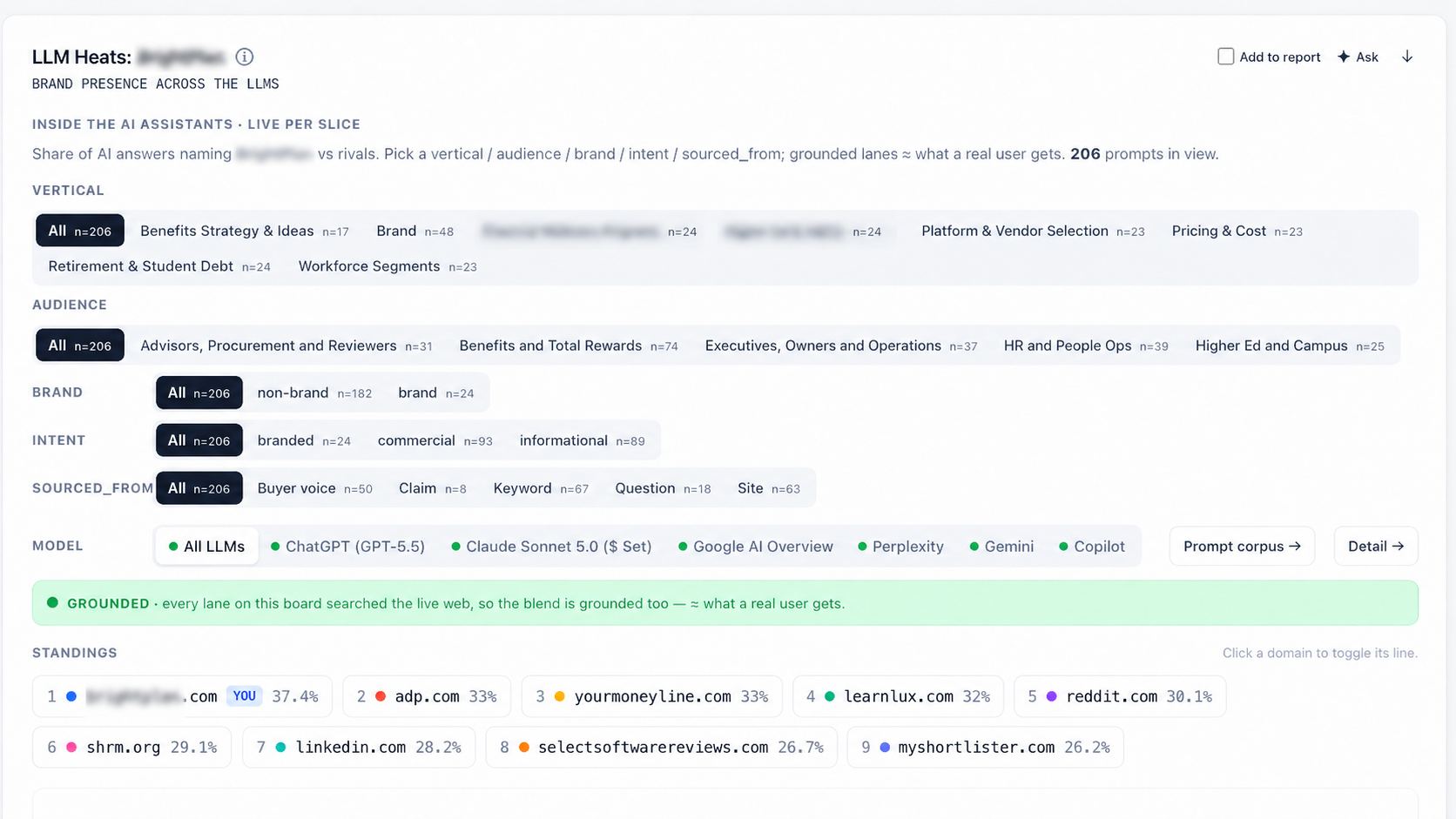
Real prompt measurement is like polling. Answer-engine output shifts with account history, location, and model version, so the same prompt returns different answers across runs. A genuine AIO/AEO agency responds by sampling: many runs per prompt, a reported range, and variance should be treated as a signal about how stable your brand’s presence really is.
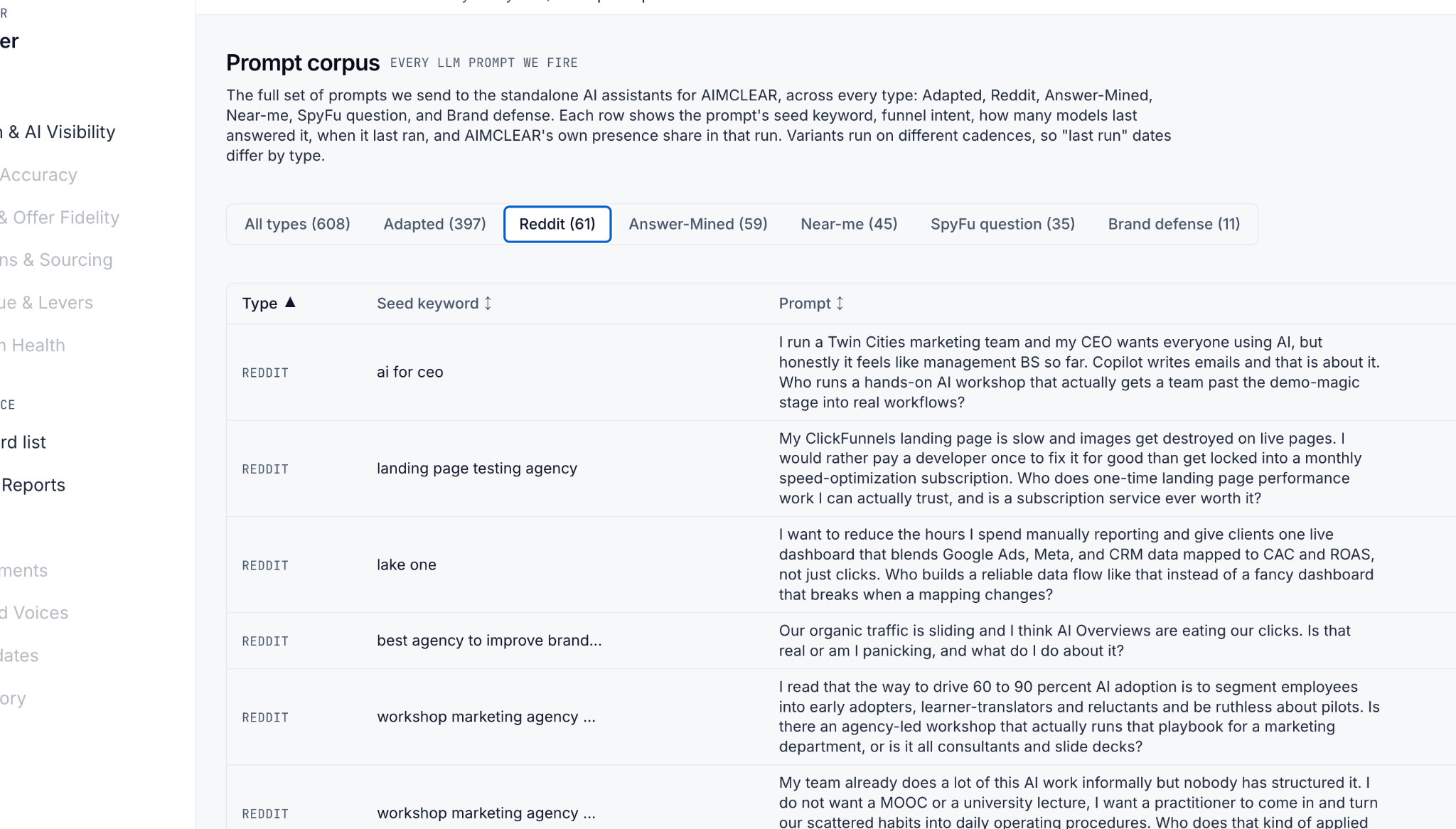
Any visibility figure depends on the queries measured, engines used, locations sampled, and the date. A real AIO/AEO shop states the denominator before showing a single chart, keeps each engine on a separate lane (because two engines cite the same domains only a fraction of the time), and stores raw answers so metrics drift is traceable.
An SEO repackager hands you one blended score and proves it with a screenshot from a personal, logged-in account, which reflects one person’s history and is little more than an anecdote. Or they use a limited, expensive tool, which may or may not be measuring the correct data and filter pivots.
Ask how they came up (fanned) with the prompts they’re testing in which LLMs? Read up, the major toolmakers argue with each other about measuring the wrong signals and many believe emergent AIO/AEO tools currently being gobbled up by PE represent a bubble.
Can a machine reach and read pages they’ve worked on?
“Retrieval” sets the ceiling for everything downstream. A real operator confirms reach at the infrastructure level by reading server logs, seeing which AI crawlers requested URLs, at what frequency, and response codes. “Rendering” is tested the way a machine experiences it, because many assistants skip JavaScript. A genuine AEO/AIO agency fetches the page as plain HTML with scripting disabled and watches for the content, navigation, and actions that vanish, since whatever disappears stays invisible to the agent regardless of how the page looks in a browser.
A lipstick on a dustbin shop discusses last year’s take on schema, and treats pages that render in Chrome as perfect for a model to read. Crawlable HTML, visible internal links, and clear on-page actions form the infrastructure of AI visibility today.
Do they optimize passages or whole pages?
Answer engines assemble responses from passages, so severable snippets, not whole pages, become the unit of work. AI models decompose questions, pull specific spans to answer each part, and stitch them together. Web pages earn citations by seeding clean, quotable answers throughout, each anchored to a real question a buyer or a model may ask. The strongest measured gains in non-branded AI visibility start with dedicated fact pages that leave extractable breadcrumbs, with concrete dates, numbers, and named entities a model lifts without ambiguity.
Real AI search consultants build and audit at the passage level and show machines stand-alone answers inside the page. A poser shop optimizes one URL for a head keyword, counts word density, and ships a wall of slop that only holds together when read top to bottom.
Where does corroboration come from off the site?
A key component of AI model “trust” comes from independent repetition, akin to PR. A brand telling its own story counts as one signal, while reviews, community threads, earned media, and reference sites telling stories move the model from a brand claim to social consensus.
Partners worth your blood money help earn real mentions, monitor the community surfaces models ingest, and strengthen entity signals, meaning consistent naming and clean associations.
Earned notoriety helps models resolve brand identity with confidence. The old game chased backlinks for ranking authority, and the new game needs corroboration for citation trust, so link volume alone falls short. A real SEO/AEO/AIO these days explains the difference and refuses short-sheeted versions, since planted posts and AI-drafted persona accounts create durable negative evidence that lives in the exact feeds models read, and the residue outlasts the deleted post.
Real SEOs ask about your category narrative, distinctive first party data, and the strength of your existing associations, and it connects brand budget to search performance through the branded demand each one feeds. A repackaged SEO slop firm scopes keywords and pages and leaves brand to someone else.
We have a fun inside joke at AIMCLEAR – what marketers today call “AEO” is what smart marketers have always defined as solid branding. Modern organic marketing agencies treat brand strength as the primary input to AI visibility. Testimony and documents from the DOJ antitrust trial revealed how heavily Google’s systems weight brand-driven click signals (NavBoost). A model that has encountered your brand described consistently and searched for by name reaches for you when the question fits, which turns a generic recommendation into a named one.
Visibility now spans far more than a website. Presence runs across social platforms, video, product feeds, community forums, and the AI surfaces that read all of them. A real SEO/AEO/AIO agency plans PR and earned media as part of the visibility program, because credibility now turns on whether AI systems trust and recommend a brand. Press, reviews, and third-party validation form the corroboration models lean on, so PR and AEO share one goal rather than being silos.
Google made the shift concrete. Search Console now offers platform properties that report how your Instagram, TikTok, X, and YouTube content performs in Google Search, so presence on social surfaces has become part of search reporting. A real agency tracks visibility across every surface where your audience searches, connects earned media to citation trust, and reports the whole picture. A repackaged shop reports website rankings alone and treats social, video, and press as someone else’s job.
Do they run search and AI search as one system?
A real SEO/AIO/AEO holds search and AI search as one system with shared inputs and divergent outputs, and articulates what genuinely differs about retrieval, passages, and corroboration while refusing to silo the work into a separate team with separate tricks.
Expertise is expressed in handling the tradeoff: edits that make a page easy for a model to quote can strip out the depth, brand cues, and internal structure that organic search rewards, so a citation can arrive while a ranking slips away. A genuine shop names the risk aloud, checks organic performance before and after every AEO change, and counts a citation bought with a lost ranking as a cost. A repackaged shop promises upside on the new surface and stays quiet about the price on the old one.
Some experts believe unique, helpful, agent-ready content is the entire game, so a shop selling GEO as an exotic new craft edges toward theater you want to avoid. Others agree directionally and favor one team and one strategy. An opposite camp espouses a cross-functional GEO staffing slate and the builders treating SEO agents as four-layer architecture, seeing genuinely new specialized execution that needs its own roles. Honor the diversity of emergent practices among thought leaders by demanding integration and mechanism-fluency at once.
Will the tactic still work in six months?
A real operator is candid and humble about potential decay. Structured-data formatting tricks, forum-mention farming, and single-file uploads are usually short-lived, because platforms patch an exploited shortcut once enough sites pile in. An old world SEO agency that anchors your program on a fad or a decaying trick is selling a countdown to failure.
A real AIO/AEO thought leader builds human-in-the-loop unique, helpful, reachable content that pays your brand dividends that compound. A repackaged SEO shop presents shiny objects as the strategy, because a concrete trick sells faster than the unglamorous work of becoming genuinely worth citing.
“Fielding a diverse program with classic brand values indicates you’re dealing with true consultants.” Lea Scudamore, AIMCLEAR Director of Search and AI Visibility
There are some flashy exceptions. Tom Orbach documented the /pricing.md twin as ‘the easiest win of the year,’ verified across real SaaS sites. We’re testing it ourselves as an agent-fetch play. Barry Schwartz, famed search journalist, relays the counter from Google and Bing that a separate markdown page adds crawl load and risks cloaking. We’re testing the twin as an agent-fetch play rather than a search-indexing play. So, some structured tactics read as potentially durable agent-era infrastructure, and a growth program should test rather than dismiss.
Show Me the Money or STFU
A real consultant reports influence and traces it to money. The value of AI visibility is usually measured downstream: someone sees your brand recommended, remembers the name, and later searches for you or arrives direct, so a large share of AI-influenced demand returns through branded search and direct visits.
A genuine agency measures branded-search lift, source inclusion, and conversion quality, and reports recommendation durability, meaning whether your recommendation survives the second and third turn of a buyer conversation, since a large share of recommendations fade after one qualifying question.
A reupholstered SEO dinosaur reports rankings, impressions, and sessions, counts an AI Overview and organic listing as two impressions, calls traffic a result after the KPI has since moved to influence tied to revenue. Chase the downstream outcome first and read the citation as a leading indicator that earns its place only when it connects to branded demand and conversion. Report candidly to the one question finance actually asks: How much money did we make.
So how do you tell a real AI search agency from a repainted SEO shop? Well, they:
- Explain what actually causes an AI citation: retrievable pages, self-sufficient passages, and independent corroboration.
- Measure brand mentions, linked citations, visibility variance, and revenue as separate signals.
- Verify whether AI crawlers can reach, render, and read the content.
- Optimize individual passages for extraction instead of stuffing entire pages around head keywords.
- Build corroboration through earned media, reviews, community conversations, social platforms, and trusted third-party sources.
- Protect traditional search performance while improving AI visibility.
- Test tactics continuously, acknowledge uncertainty, and avoid building strategy around short-lived loopholes.
- Connect SEO, AEO, AIO, PR, brand, analytics, and conversion measurement into one operating system.
- Trace visibility gains to branded demand, qualified conversions, and revenue.
Real AI search agencies understand the mechanisms, prove their work with data, and keep business outcomes at the center. Repainted SEO shops fall back on rankings, schema tricks, screenshots, blended scores, and shiny tools because the old playbook is the only one they know.