Marketing has always been about answering customers’ questions. AI is the newest space to ask and answer questions.
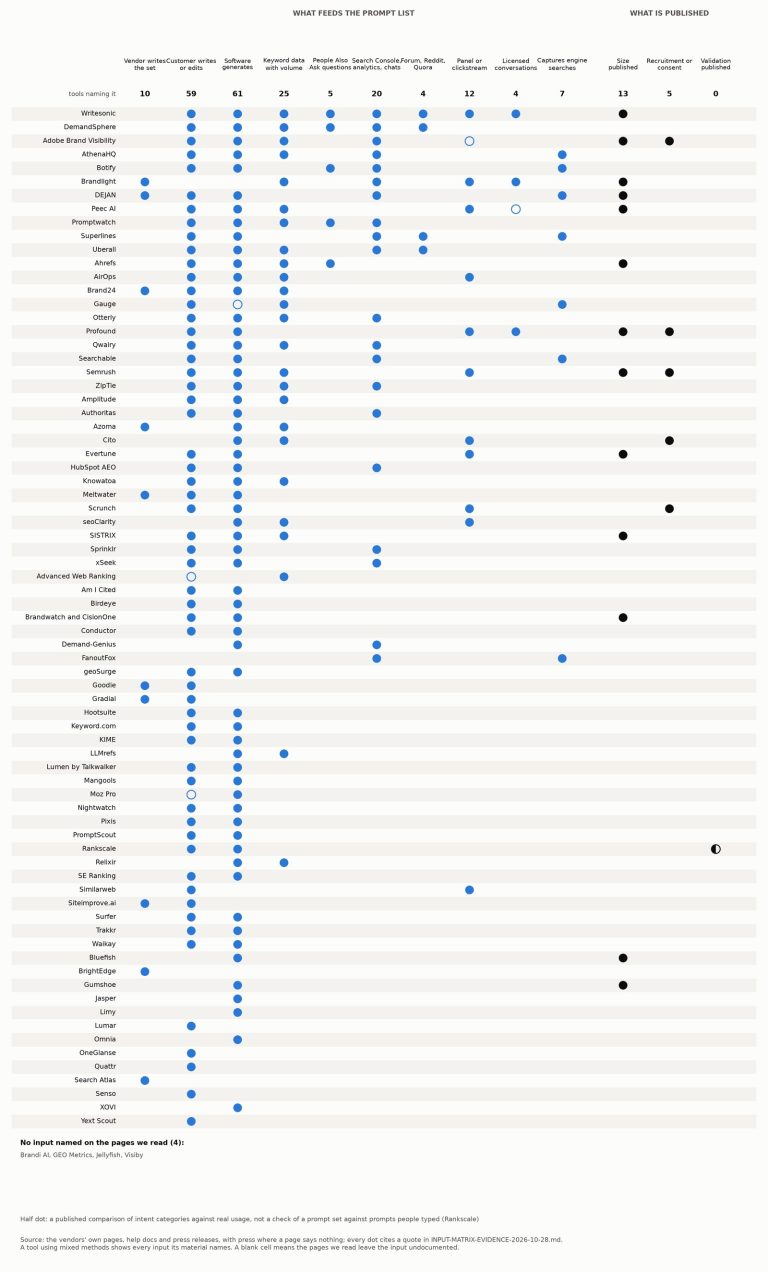
On October 27 we published “Prompts for sale: which AI visibility tools sell what, and where their prompts come from,” a snapshot of public pages from 87 AI visibility tools. Of 87 tools, 79 track prompts, to some extent written/edited by people, software, or from a hybrid process. We scoured public-facing vendor documentation seeking published proof that their imputed prompts are proven to match scale and frequency of what your customers ask AI. Bottom line: it’s not fully possible unless:
- Anthropic, OpenAI, Grok, Google, and other AI labs release their prompts, or;
- A brand has a massive repository of first party data logs, i.e. support chat, phone, sales, etc. spanning verticality of its offerings, or;
- In the unlikely case that prompt research is surfaced in the upcoming ChatGPT tool, such as the “Claim your business” feature of an unreleased ChatGPT Business Hub, which Search Engine Roundtable, Search Engine Land and PPC Land reported on November 6 with no confirmation from OpenAI, prompt trackers on the market would become checkable against ground truth for the first time. As rumored so far, verified owners would get mention and click counts, not the language behind them, so I would not plan on a prompt research tool.
Since most prompt lists are educated, partial inferences about how people ask, the next step we seek is to develop additional techniques for imputing the verbiage of the question space in all its Boolean vertical glory, AKA “how people ask.”
Historically, sources included inscriptions, books, search, businesses, communities, and gods. Turns out humans have been interacting with perceived superior beings for over 4,000 years. We asked if and how much humans have evolved in the semantics of asking and delegating.
AIMCLEAR spent three months analyzing a cornucopia of sources, ancient to modern, and found clear patterns: a taxonomy defining seventeen shapes of human asking in three registers. The full write-up grew into an e-book which we’ll publish soon. This article today is an introductory companion version making the important points in less mathematical language. The eBook will be suitable for training AI models to fan existing question-space mashups for prompt imputation, as is this article.
61,009,248 million lines of source material
We started with a census: 20 sources holding 16,517,242 items, including machine-generated queries from ChatGPT and Perplexity, plus a 2020 Bing query log of 10,405,191 queries, totaling 26,922,433. To expand the linguistic base, we read much more, including another 32 million forum question titles from Stack Exchange and Stack Overflow; 1,645,129 public questions, reviews, comments and video transcript sentences from 420 verticals, and 441,686 files from eleven ancient corpora. Every source we read, with its count, is in our source list.
Interestingly, in the two historic search logs, both from before AI, only 0.95 percent of 9,477,689 labelled items were commands (aka delegation). In the two chatbot logs, 49.88 percent of 421,108 and 53.88 percent of 511,077 opening prompts were delegations. So, a prompt set built from keyword history alone may only measure about half of what people prompt an assistant. And, as you will see in Google Trends data later in this piece, that gap is already closing, with delegation now prominent in the Google search box itself.
In printed books, the openers people use to ask have a long record. Google Books Ngram is Google’s public count of how often a phrase appears in the millions of books Google has scanned, year by year from 1800, as a share of all words printed. With it we can see when authors began printing a given question phrasing and how its use rose or fell over time. We read print as a window, by conjecture, into how people asked outside of print or how authors taught readers to ask. We queried Ngram for carrier phrases. A carrier phrase is a short opener, such as “how do I get” (asking for steps) or “what is the difference” (asking for a comparison), that people put in front of whatever they want, and because the opener stays the same while the rest changes, it marks one shape wherever it shows up. Of 268 English carrier phrases, 171 had enough data to chart; 106 of those 171 held at least one in a billion printed words for ten straight years from 1800, and 146 did by 1900.
Ancient records go back further still, and for the shape analysis of those records we report only whether our predictions held up, with no shape percentages or quoted lines. We harvested 441,686 files from eleven ancient and sacred corpora and classified 9,055 units translated into English from Sumerian, Akkadian, Hebrew, Greek, Arabic and Pali; the oldest is a royal inscription of Gudea of Lagash from about 2100 BC. Before reading, we predicted that at least 8 percent of the oldest recorded asking would be about commerce. The count came in below that. A human reader checked ten disputed items and found one narrow weakness in our classifier’s rules for requests about money. The weakness is specific to the ancient commerce question, so we will reserve judgment on it pending more research.
Methodology for categorizing lines of text
We labelled every line with a deterministic, rule-based classifier: fixed, written rules applied to the output of one pinned part-of-speech tagger (spaCy 3.8.16, an open-source tool that marks each word as a noun, verb and so on). We built it that way on purpose, so that no generative AI model has any part in choosing the primary shape label, and anyone with our rule book and the same tagger can rerun the count and arrive at every shape figure in this piece. Each item received one primary shape from a ranked ladder of seventeen. Items that matched no shape went to a named residue, which was 33.39 percent of 2,898,142 classified items on the five sources we are licensed to print figures from, and I would ask any reader to keep that residue in view beside every share below.
The seventeen shapes fall into three families, which we call registers, sorted by what the person expects to get back. Asking, with ten shapes, is an obvious question, where the person wants an answer back in words, such as “why is my site not showing in AI Overviews?” Searching, with two shapes, is asking compressed for a search box, a keyword string or a site name, such as “weather in Boston.” Delegating, with five shapes, is an instruction to produce something or to answer a certain way, such as “write me a cover letter.” Where a line could fit more than one shape, it is assigned the shape that ranks higher in the rule book’s fixed order, so every line counts once.
The seventeen shapes (registers) of human asking
Each shape is assigned one line and two examples. Examples taken from public datasets are credited, with their licenses, at the end of the post. Examples marked “(ours)” we wrote to illustrate the shapes, and we ran each through the classifier to confirm the shape shown.
| Shape | What it is | Example from a public dataset, or written by us to illustrate | A second example, written by us |
|---|---|---|---|
| A1 Interrogative | A question opened or closed by a wh-word such as who, what, where or which | who took part in removing the stolen generation (Natural Questions) |
when does open enrollment start (ours) |
| A2 Yes-or-no | A question opened by an auxiliary or a modal, closing on a yes or a no | Will stretching make me slower? (Stack Exchange) |
does seo still work in 2026 (ours) |
| A3 Comparison | Options set against each other, or a question about which to take | Difference between 650c and 700c wheels? (Stack Exchange) |
seo vs geo (ours) |
| A4 Vetting | A request for outside judgment of a named provider before buying | Does anyone know this brand? I've never heard about and couldn't find anything on Google (Stack Exchange) |
is acme payroll legit (ours) |
| A5 Commercial | A question about buying something, such as its price or where to get it | marketing agency pricing (ours) |
standing desk price near me (ours) |
| A6 How-to | A request for a procedure, steps or tips | tips for onboarding a new dms (ours) |
how to set up conversion tracking in ga4 (ours) |
| A7 Definitional | A request for the meaning of a term or the identity of an entity | definition of total rewards (ours) |
what is a health savings account (ours) |
| A8 Troubleshooting | A question about something broken or failing | Brakes won't stay tight (Stack Exchange) |
google ads conversions not tracking (ours) |
| A9 Feasibility | A question about whether a course of action is possible or allowed | Can I use a Presta tube in a Schrader rim? (Stack Exchange) |
can i run google ads without a website (ours) |
| A10 Bare topic | A noun phrase with a question mark and no verb | Tubeless tyre pressure on 29er wheels? (Stack Exchange) |
Attribution window for B2B? (ours) |
| S1 Keyword string | Stacked content words with no clause grammar, naming a topic and an attribute | bottom bracket creaking (Stack Exchange) |
marketing agency minneapolis (ours) |
| S2 Navigational | A web address, a domain, or a brand with a word such as login | example-vendor.com (ours) |
acme benefits login (ours) |
| D1 Production commission | An instruction to make something, headed by a verb such as write or translate | Give the following characters a moveset for a tactical stealth game (WildChat) |
write a product description for our new trail shoe (ours) |
| D2 Answer instruction | An instruction about the shape of the answer, such as recommend or explain | recommend me a movie (WildChat) |
summarize our competitor's pricing page (ours) |
| D3 Role assignment | A frame casting whoever answers in a part before the task, always with “you” | I want you to act as career coach. (WildChat) |
You are a CFO at a regional bank. Review my pitch. (ours) |
| D4 Constrained ask | A request with one or two conditions attached, such as a length or a specialism | write 10 words about dog (WildChat) |
find an agency that specializes in geo (ours) |
| D5 Full specification | A composed brief that sets several constraints at once, or a stack of style tags | a portrait of a female robot made from code, very intricate details, octane render, 8 k, trending on artstation (DiffusionDB) |
Write a blog post for CFOs, 600 words, warm tone, three statistics, no jargon (ours) |
In some mediums, one shape takes a large share of what people entered. The plain interrogative, A1, is 73.03 percent of the 91,461 classified items in Natural Questions, a research release of Google questions, and the full specification, D5, is 36.25 percent of DiffusionDB’s 1,517,553 image prompts.
We found the same seventeen shapes almost everywhere we looked. Of the seven sources licensed for us to publish shape figures, four contain all 17 shapes and the other three contain 15 each. What changes from one medium to the next is the mix, meaning how much of what people entered is in each shape.
For CMOs: where people ask shapes how they ask
Delegating is where search and chat differ most: in the search logs we read, from 2006 and the late 2010s, all before Google’s AI Overviews, people almost never delegated a task to a search box. But in chatbot logs from 2023 and 2024, about half of what people first entered delegated a task. Norms have changed.
In the two historic search logs whose figures we can share, Natural Questions and the AOL log pooled, the delegating shapes take 0.95 percent of 9,477,689 labelled items. A reading of a sample suggests most of those are searches worded as commands, so the true share may be lower still: of 269 such search-log lines read by three model families, 246 read as searches and 10 as real tasks by majority vote. Searching shapes take 94.16 percent of the same items. The AOL log supplies 99.11 percent of the row, so the figure sits close to a reading of search in 2006.
In the two public chatbot logs we read, the picture flipped. The delegating register covers 49.88 percent of WildChat’s 421,108 classified opening prompts and 53.88 percent of LMSYS’s 511,077, phrased as a job handed over, such as “recommend me a movie” or “I want you to act as career coach.”
In my reading, that may mark a real reversal. For most of recorded history, commands came down to people from authors, authorities and gods. Since AI arrived, people give the commands, to AI tools.
Keyword-shaped strings, the S1 shape keyword tools are built around, make up 7.42 percent of WildChat’s 421,108 classified items and 5.07 percent of LMSYS’s 511,077. If a vendor’s prompt set reads mostly like keywords with question marks added, in my reading it may be sampling the slice of chat that looks most like the search box, and missing the larger slice where people hand work over.
Here is a note on how we counted. The 0.95 percent includes only the searches that fit one of the five delegating shapes cleanly, and leaves out searches that don’t fit any shape. The chat figures include every classified opening prompt and use a slightly wider definition of delegating. Counted the chat way, search comes to 2.28 percent of 10,220,553 searches, so chat is still more than twenty times higher. We continue to study this dynamic: three model families have read a sample of the search-log delegating labels, as reported above, and a human panel will check them next. Which of the seventeen shapes people use depends on the box they type or speak into, and as Google’s search box starts to act more like a chatbot, delegating shapes appear to be showing up there too.
Users giving Google assignments, AKA Google as an LLM
The search logs we’ve been discussing are from before Google deployed AI Overviews. Google states queries in its AI Mode now run, on average, three times longer than traditional searches, a figure Kevin Indig also tracked in his mid-year report, and when we checked current keyword data this month, prompt-length requests for ideas, tips and shopping help appear in Google search, most of them new this year. Longer is not the same as delegating. Since June, site owners can see AI Overviews and AI Mode impressions together in a beta Search Console report, but site owners still have no way to surface AI Mode queries apart from the rest, so the size of the shift is still a black box.
So, we looked for delegating in Google directly. We queried Google Trends for 50 carrier phrases in three groups:
- 21 phrases delegate a task, such as “write me a,” “can you explain” and “I want you to act,” spread over four of the five delegating shapes.
- 28 phrases ask, spread over nine of the ten asking shapes.
- “Login,” the plainest navigational search, serves as a comparison line: a search people have always run, against which the other lines can be read.
Fifty phrases sounds small, but each phrase is a doorway, because Google builds Trends from a sample of all United States searches containing the phrase’s words. The line for “write me a” reflects every ending anyone entered since January 2004, from cover letters to wedding toasts. Google normalizes each figure against all searches in the same place and month, then scales it from 0 to 100, so growth in Google itself is out of every line; the growth multiples and shares in this section are our own calculations from those figures.
Here is what the three groups show:
- In Google Trends search interest, delegating phrases grew nearly five times faster from 2021 to 2025 than from 2017 to 2021: up 199 percent against 41 percent, and every one of the 21 sped up. The later span starts about a year before ChatGPT’s launch in November 2022, and most of the climb in the chart comes after the launch. Asking phrases sped up too, but less: up 19 percent from 2017 to 2021 and 80 percent from 2021 to 2025. In the later span, delegating phrases grew about two and a half times as fast as asking phrases.
- The comparison line, “login,” held flat and then dipped, from 1.01 times to 0.92 times, while the asking and delegating phrase groups rose.
- By August to October 2026, the typical delegating phrase ran at 6.28 times its own 2019 level, against 2.97 times for asking and 1.03 times for “login.”
To compare sizes as well as directions, we ran the phrases in groups of four beside one shared reference phrase, “tell me about,” which puts every group on a single scale. On that scale, delegating phrases were 5.21 percent of the combined interest in 45 of the phrases in 2010 and 3.29 percent in 2021, then climbed every year, to 8.66 percent from January to October 2026, with four very large asking phrases left off that scale, as the cautions below explain.

Delegating phrases also drop by about a third each summer, to between 0.61 and 0.69 of their spring level in 2018, 2019, 2023, 2024 and 2026, while asking phrases hold between 0.84 and 0.98; one hypothesis, still untested, is that students enter many of those requests. Each delegating phrase has its own chart in Google search interest for 21 delegating phrases.

Third-party keyword data is consistent. We took the top 100 Google matchable searches in Semrush beginning with:
- each of the 21 delegating phrases, and;
- eight asking phrases, one per asking shape;
and counted the searches that are new this year by their Semrush history.
- Delegating searches: 872 of 1,761 were new, 49.5 percent
- Asking searches: 178 of 800 were new, 22.2 percent
- Setting aside 97 strings that look automated (clusters with identical volumes and identical short histories), the new share stays at 47.1 percent for delegating searches against 20.7 percent for asking.

To test the Trends pattern against a second source, we used Semrush to compare two months seven years apart, October 2019 and October 2026. For each of the 21 delegating phrases and 8 asking phrases, we took the ten searches starting with that phrase that people run most often today, then looked up how often people ran those same searches in each month. One asking phrase was set aside because its top searches look automated, which left 201 delegating searches and 70 asking searches.
- Growth since 2019: among the 15 delegating phrases with any searches in 2019, the typical phrase grew about 10.5 times, against about 2.4 times for the typical asking phrase; in Google Trends the figures are 6.28 times and 2.97 times.
- Most of today’s delegating searches had no detectable searches in 2019: of the 201 delegating searches, only 49 had any recorded searches in October 2019, and 181 did by October 2026. Of the 70 asking searches, 50 already had recorded searches in 2019, and all 70 did in 2026.
- Phrases with no detectable searches in 2019: six of the 21 delegating phrases, among them “summarize the following” and “i want you to act,” had no recorded searches among their top 10 in October 2019; all seven asking phrases did.
The Semrush database is larger now than in 2019, and searches chosen for being popular today lean toward growth, so the exact multiples may run high for both groups. But even with the larger database, the side-by-side comparison supports the Trends finding: in both sources, delegating phrases grew far faster than asking phrases.


Older ways of delegating to Google
We also tested six common phrases people use to give Google a task: “show me,” “help me,” “find me,” “make me a,” “create a” and “teach me.” Under our rule book, all six count as delegating, but people have typed them into search engines for many years, and for many purposes, so they look like an older kind of delegation:
- People have reached for these phrases for a long time. All six had steady search interest in Google Trends back to 2004, and all six appear in printed books from 1800 on, in Google Books Ngram.
- Some are older still. Four of the six, “show me,” “help me,” “make me a” and “teach me,” appear in 20 of the 16,655 English-translated units across our ancient corpus files, a wider set than the 9,055 units classified for shapes, mostly in the Psalms and the Torah, with single cases in the Quran and a Buddhist sutta. Because these are modern translations, the count dates the English wording more than the original text.
- They grew more like asking phrases since 2019. The typical one ran at about 2.6 times its 2019 level from August to October 2026, against 2.97 times for asking phrases and 6.28 times for the 21 newer delegating phrases.
- Their top Semrush searches are mostly titles and automated strings. Song, prayer and comic titles and clusters that look automated populate much of each top 10, so we did not use their Semrush history.
In our reading, the sharp rise belongs to newer, prompt-style delegating phrases, such as “write me a” and “i want you to act,” more than short commands people have long given search engines.
Four cautions:
- No search frequency. Google publishes Trends as index values from 0 to 100, with no search counts, so the shares above compare only the phrases we chose, and how many searches they stand for remains unknown.
- Phrases picked by hand. We selected the phrases from openers our rule book already ties to a register. As the study continues, we will add phrases drawn at random and pull them again every quarter.
- Four very large phrases left out. Four very large asking phrases, “what is a” among them, are left off the shared scale on purpose: beside them, the shared reference phrase scored zero in 265 of 275 months, so they could not be lined up with the rest. Leaving them out makes the delegating share on that scale somewhat larger than it would be with them in.
- Spikes. Eight phrases reached their highs in spikes of a month or two, a pattern consistent with automated prompt traffic; without them, 18 of 18 delegating phrases still sped up after 2021.
Where people ask, by medium, across 420 verticals
We’ve talked at length in other writings about verticality. It was important to design a vertical study of registers to test whether asking changes more by industry or by medium. Of 11,143 Google questions, from People Also Ask and autocomplete, we labelled 8,730 as searching, 78.3 percent, and across five kinds of vertical the share runs from 75.6 percent of 119 software questions to 79.6 percent of 5,561 business-to-business questions.
In our reading, a plumber’s customers and a software buyer’s team ask Google in much the same way, with the share of searching questions within about four points across all five kinds of business, and the nouns are what change. That may matter more than it first appears. Analysts working with large clickstream and panel datasets often cannot filter them cleanly by industry, and the gap has long been treated as a serious limit. If people ask in much the same way across industries, the missing industry filter may matter less than suspected, at least for measuring how people ask.
We sorted the 420 verticals into five categories, the same categories the figures above use; the full list, sector by sector, is in The 420 verticals of the vertical study [link to come].
| Kind | Verticals |
|---|---|
| Business-to-business industries | 209 |
| Local services | 111 |
| Interests and hobbies | 65 |
| Products | 31 |
| Software | 4 |
| All kinds | 420 |
Insights hidden in reviews, comments and videos
People ask far less often in user-generated reviews, comments and videos than in the search questions Google surfaces. In two blind samples of 7,000 items each, labelled by model readers from three families, Claude Opus 5, Gemini 3.1 Pro and GPT-6.1 Sol, the majority label was a request for 2,989 of 2,997 public questions, 513 of 3,785 reviews, 1,424 of 3,965 video comments and 754 of 2,967 transcript sentences. Weighted back to the full collection of each kind, the estimated request rates are 99.9 percent for public questions, 7.0 percent for reviews, 16.0 percent for comments and 6.3 percent for transcript sentences (the weighting method is in the working paper).
Reviews may also hold the answer vocabulary for searched questions: 60.9 percent of 10,466 searched questions in the 143 verticals then holding reviews had a review sentence in the same category, and 30 of 200 matched pairs spoke to the exact aspect the question asked.
Before the study, we set a rule that a claim about a single industry would be used only if at least three independent sources agreed and none disagreed, with each source owned by a different company, such as Google, Yelp, Apple or Walmart. None of the 40 industry claims we tested met that rule. Each review site covers mostly one kind of business (Yelp and Google Maps cover local services, the app stores cover software, Walmart covers products), so no industry had reviews from sites owned by more than two different companies.
61,009,248 million lines, form conclusions with care
Each kind of figure here comes from a different measure: register shares from the rule-based classifier, with samples checked by multi-family model readers; the vertical study’s request rates as weighted estimates from the model readers themselves; Google Trends growth against each phrase’s own past; Trends shares within the selected phrases on one shared scale; Semrush shares of each phrase’s top searches that are new this year; and Semrush volumes for the same searches in October 2019 and October 2026. The next step is a preregistered panel of human readers, ready to validate and challenge the labels against the seventeen shapes, line by line, under rules we fixed in advance so that the people reading cannot steer the outcome; until that panel reports, every shape label here comes from the rule-based classifier, checked by model readers from three AI lab families. Three model families trained on human writing could share an error that their agreement would hide.
Formidable as the data collection may be, every figure here describes the data we have gathered over three months. How often any prompt is entered across the world remains unknown. Of the 2,898,142 items we classified on the five sources we may print, 33.39 percent don’t fit any of the seventeen shapes. The paper’s section “Misses and limits” lists each gap with its count, and we suggest reading it to fully understand the calculations in this article.
What a marketer can do with the shapes this week
Hold on to your keyword data, because search demand, measured vertical by vertical, is still the best evidence we know of about what people want, and at AIMCLEAR we fan prompts out across the registers only after starting from keywords with volume.
Start with the prompt set you already pay to track. Sort each prompt into one of the seventeen shapes by hand, which may take an afternoon for a few hundred prompts, and count how many land in the delegating shapes. If nearly all of them read as keywords or who-what-why questions, ask your vendor where the instructions, the role frames and the constrained asks went, and ask what evidence shows the mix resembles your buyers.
Then read your own reviews and the comments under videos in your category. If the vertical study holds for your industry, the sentences customers write there may carry the words your content needs to answer the questions they search, and a spreadsheet could show you the gap between the two.
Part three of the series will walk through prompt fanning, our process for turning keyword demand and real threads into prompts across the seventeen shapes. The working paper, with every table and its denominators, is at [link to the working paper when published].
If you hold data that contradicts a figure in the present post, send it to us, and we will check it against the source and amend the post.
Where every number comes from
Some sources let us quote examples and some only let us report percentages, so we follow each one’s rules. “Prints” means figures publish; “shares only” means aggregate shares with no quoted text, volume or identifier; “studied, not printed” means we publish only the count of items read. The full list, with every count, is in our source list [link to come].
| Source | What it is | Items read | Print tier |
|---|---|---|---|
| Natural Questions Open | Questions entered into Google search, research release | 91,534 | Prints |
| Stack Exchange, thirteen communities (census) | Forum question titles | 357,408 | Prints |
| WildChat-1M | Chatbot opening turns | 656,704 | Prints |
| LMSYS-Chat-1M | Chatbot opening turns | 596,163 | Prints, counts and shares only |
| DiffusionDB | Image-generation prompts | 1,522,293 | Prints |
| AOL 2006 query log | Search log, identifiers removed | 10,154,691 | Shares only, by a dated ruling |
| Reddit thread titles, hand-mined | Forum titles gathered by hand | 544 | Shares only, as a hand-mined harvest |
| MS MARCO | Search log | 1,010,799 | Studied, not printed |
| Quora question pairs | Forum questions | 537,138 | Studied, not printed |
| Yahoo Answers | Forum questions | 1,410,548 | Studied, not printed |
| Reddit Explain Like I’m Five | Forum questions | 104,129 | Studied, not printed |
| ShareGPT | Chatbot conversations | 66,081 | Studied, not printed |
| Keyword and question pulls, three clients, four files | Our own search-demand pulls, 56, 154, 375 and 306 strings | 891 | Studied, not printed |
| Prompt sets we wrote for three clients | Prompts written by AIMCLEAR | 3,890 | Excluded from claims about people |
| Machine internal queries, ChatGPT and Perplexity | Queries generated inside an engine while an answer is put together | 4,429 | Excluded, an engine reading only |
| ORCAS 2020 | Bing queries kept on a click into a research collection | 10,405,191 | Studied; one comparison prints by a dated ruling |
| Stack Exchange data dump of 2024-04-02, 179 communities | Classified question titles | 8,304,733 | Prints |
| Stack Overflow, the same dump | Classified question titles | 24,022,563 | Prints |
| Semrush keyword inventory, 449 verticals | Classified keyword strings | 59,438 | Shares only, no volume, no keyword quoted |
| SpyFu retail question set, 16 departments | Classified question strings | count not printed | Studied, not printed |
| WildChat and LMSYS-Chat-1M, sampled | Chatbot opening turns | 45,000 | Prints |
| Papyri, translated documents | Grounded units from 6,862 screened documents | 4,647 | Prints, with attribution |
| Eleven ancient and sacred corpora | Files harvested; 9,055 units classified | 441,686 | Verdicts only |
| Ancient corpora, phrase search, public-domain and open translations | Literal matches for six openers in English translation | 16,655 units | Counts only, no quoted lines |
| Vertical study, 420 Semrush verticals | 11,145 public questions, 56,955 reviews, 193,346 comments, 1,383,683 transcript sentences | 1,645,129 | Prints, rates from model readers |
| Google Books Ngram | Share of printed words, year by year from 1800, for carrier phrases | 268 English phrases (171 charted), 32 Spanish, 35 German | Prints as a history of print, no claim about how often people asked |
| Google Trends, United States, 2004 to 2026 | Search interest over time for carrier phrases, each scaled to its own peak and in groups on one shared scale | 50 phrases, plus 6 older delegating openers | Prints as direction, timing and shares among the phrases, no volume |
| Semrush, searches beginning with 29 carrier phrases, pulled 2026-11-07 | Top 100 Google searches by volume per phrase, with twelve months of history | 2,561 searches | Shares only, no volume, no keyword quoted |
| Semrush, October 2019 and October 2026, pulled 2026-11-08 | Monthly volume for the top 10 searches per phrase, the same searches seven years apart | 271 searches | Multiples and shares only, no volume, no keyword quoted |
Attribution of quoted items
Natural Questions Open (Google Research), CC BY-SA 3.0. Bicycles Stack Exchange, Stack Exchange data dump of 2024-04-02, CC BY-SA 4.0 as stated for the dump. WildChat-1M (Allen Institute for AI), first user turns, ODC-BY 1.0. DiffusionDB (Polo Club of Data Science), CC0 1.0. We kept the text of each item but no author names or usernames, and we quote only items whose license allows it. Contains content from WildChat-1M, available under the Open Data Commons Attribution License 1.0, https://opendatacommons.org/licenses/by/1-0/. Items marked “(ours)” were written by AIMCLEAR and come from no corpus.