Preface
Prompts are the evolution of keywords. To measure how often AI tools mention, recommend, and link your brand, you need to track prompts. Choose the wrong prompts and your visibility scores may be off, no matter how credible the dashboard looks.
We studied 87 AI visibility tools and found no published proof their tracked questions are accurate vertical conversations your customers have with AI or the scale thereof. Some readers may be fighting angry after that single statement, so we ask you to read on for the math.
People using LLMs for AI research often engage in ongoing conversations, where each follow-up question builds bi-directional context (user and LLM) on previous exchanges, often account-wide. Tracking single, partly synthesized prompts can miss how customers actually research and make decisions. AI companies don’t release prompt data, so measurement vendors have to estimate. Most vendors synthesize prompts to some extent, some melding traditional search data. Others buy records of real AI conversations called clickstream and panels, which at least one vendor says are stripped of personally identifiable information (PII).
Sounds good, right? Not really.
The math gets ugly. A billion clickstream records or panels may contain hundreds of millions of individuals, but how many in the sample are YOUR customers? Narrow the data to your brand’s industry, target buyer, location and buying intent, and millions of conversations can become a handful or even zero. Vendors fill gaps by melding customer records, sales calls, support questions, search data, AI-generated prompts and other elements. Many include useful sources, but combining them, even for brands with mountains of vertical data, doesn’t prove the finished list represents what your buyers ask LLMs, how they phrase their questions, how often they ask, or specifics of how ongoing conversations wind. We do the math in the larger study below.
AI visibility tools can still be valuable in the hands of savvy managed services partners. Tracking the same questions over time shows whether AI mentions your brand, cites your website or recommends competitors. But before paying, ask vendors specifics about where their data comes from, the psychographics of the panels and clickstreams, whether their data represents your customers and what evidence supports those imputations of verbiage and frequency.
Bottom line: Brands can measure how AI answers the specific prompts they choose. But until vendors prove their questions meaningfully represent your customers, claims about your share of AI visibility are almost certainly synthesized estimates.
Introduction
Our job as marketers has always hinged on understanding the “question space,” which spans the segmentation of how customers actually structure their questions. This article is part one of a three-part series on how consumers construct their questions. The topic of this post is our study of content published by 87 tools, ranging from big SEO platforms, listening and PR suites to venture-funded boondoggles and browser extensions. Our intent is to help brands answer the question, “What are the best AI visibility platforms when it comes to building prompt sets?” In part two, we’ll release a 5-month study of human asking, drawn from a source base spanning roughly 4,100 years of human activity. It surfaced a taxonomy of “How humans ask.” Part three will walk through prompt fanning, our process for using that taxonomy to build prompt sets, with a worked example in one niche vertical. I’ll be speaking at multiple conferences in Eastern Europe over the next few weeks and will present both studies in person.
How to read this study: We begin with context on how keyword data evolved, then back it with two charts – a zoomed-out look at how the 79 tools impute prompts, and then a tool-by-tool matrix. Following the charts, we’ll detail how vendors calculate prompt volume (aka inventory or demand), methodologies they disclose, and vital validation nobody has published. We’ll also examine why panel sizes quickly collapse under Boolean verticalization pressure, common questions that our clients and prospects ask us, and four crucial questions you should ask potential vendors before you sign. The full roster of all 79 tools with source notes is in an appendix with citations, followed by our research method. So, anyone who wants to challenge a classification can follow our work.
This post is a snapshot. Vendor statements in it were read by AI between October 22 and 27, 2026, from each vendor’s public pages, or, where noted, from linked press coverage and practitioners. Vendor pages change. We may update this post when they do, though we don’t commit to keeping it current. The methodology at the end describes what we checked and how.
Today’s Market Realities
Vendors selling AI visibility measurement promote enormous panels and clickstream datasets, sometimes numbering hundreds of millions of users and billions of prompts. Boolean verticality changes the math. Narrow the data to your industry AND your target customer AND their location AND their buying intent AND the moment they are asking. Every “AND” in that sequence adds another condition that can shrink millions of observations to a handful relevant to your business.
Those vendors are forced to fill gaps with statistical modeling, weighting, generated prompts, first-party data, traditional search data, and many other elements. Combining imperfect datasets this way may produce useful directional estimates. Remember that search data has its own long tail, particularly in emerging markets where new products, terminology, and customer questions have little or no search history. That math on what the mid- and short-tail mean to prompts is fascinating, even disturbing.
And, where are the published validations showing that the resulting prompts represent how MY customers ask questions? Scale establishes size and modeling produces estimates, but representativeness requires evidence.
A brand’s own first-party data, including sales calls, support tickets, chat logs, and Search Console queries, may well hold questions real customers asked the brand directly. Those may be the best prompts a brand can track, at least as a starting point. Some brands have even better data, such as a list of actual questions customers commonly ask before they convert. But again, that data surfaces what buyers asked the brand directly, not how often people ask an AI assistant the same thing or what words they use. Therein lies a critical distinction.
<unpopular_opinion> Every prompt you engineer to test LLM output is, to some degree, either theory or fabrication. Some vendors’ techniques for engineering prompt-sets reaching towards Boolean verticalization (intent, audience, product, external factors, etc.) are likely closer to human reality than others.
Let’s keep things real. For AIO/AEO measurement-for-profit platforms, the business model centers around marking up wholesale data + labor. Convincing brands that manufactured prompts represent how humans ask is an essential proposition for platforms to make money. The current generation of organic discoverability measurement tools is a class of skillfully packaged utilities designed for an industry desperate for solutions to save jobs. Prompt imputation, as we read the market, is built on partially validated inferences packaged nicely as measurement to frustrated marketers and hungry investors. </unpopular_opinion>
I’ve personally analyzed 1,237,547,608 clickstream records, stripped of PII, so the panel math later in this article comes from experience, and what it shows isn’t pretty for anyone imputing prompts by vertical.
Prompts for sale attempt to simulate a range of how customers phrase research inquiries (“attempt” being the operative word). We tracked down how dozens of vendors manufacture their prompt inputs and scrutinized their public documentation. This proved sobering.
Context and Background
Starting in the mid-1990s, webmasters began optimizing pages for the first search crawlers – the time when dozens of search engines were vying for top-dog status, but the industry shook out to a few that went on to dominate. When GoTo went live in February 1998, web purists heavily criticized its “buy your way to the top” model. That same year Wordtracker appeared, among the earliest third-party keyword tools, scraping metasearch engines Dogpile and MetaCrawler to give marketers automated traffic estimates.
In 1999, GoTo added a search term suggestion tool for its advertisers, giving marketers unusually direct access to keyword data from a search engine. Then in 2000, Google launched AdWords and, to my mind, began its long history of narrowing third-party access to its data, which continues to this day.
Today, people still search using keywords, which have become steadily longer on average as technologies evolved, accelerated by mobile voice input and better answers. At Search Central Live NYC, 2025, Google’s John Mueller revisited the statistic that 15% of search queries Google sees are completely brand new.
For two decades, marketers could measure keyword/phrase inventory, traffic to websites, and conversion (leads/sales) – all reported at the keyword level. For a hot minute, our industry had pretty slick and relevant attribution analytics, so investments in SEO and ads could be more empirical.
Fast-forward to today, where we have LLMs, Google (AIO) AI Overviews, and AI wayfinding tools installed across many websites and applications. Key phrases evolved into prompts, which are regular language expressions, often longer, colloquial, a progression of conversational context during a chat thread. As a “conversation” with AI, prompts can also reflect emotion – and even range from a pleasant exchange to argumentative with AI.
The world tipped sideways.
- Search engines and LLMs do not disclose the inventory of the actual prompts people type, and it’s not required to sell ads.
- Output from even the same LLM can drift from pull to pull, and each family of models has a significant spread of different results.
- Marketers don’t know the exact prompt inventory and can’t easily (or at all) see segmented results or even all traffic. While the best minds in the industry are working on these problems, there is still no great answer, only imperfect solutions for impossible problems.
- The next generation of conversion tracking will likely be to segment revenue by Boolean cohorts. Slice any visibility measure we can get, anywhere. Correlate Boolean revenue cohorts to anything we can measure. Trouble is, most marketers seem to be grieving the loss of defensible data rather than moving on.
The SEO industry is going kicking and screaming, paying large fees for third-party tools built on prompt sources they cannot fully confirm.
The Data, as Promised
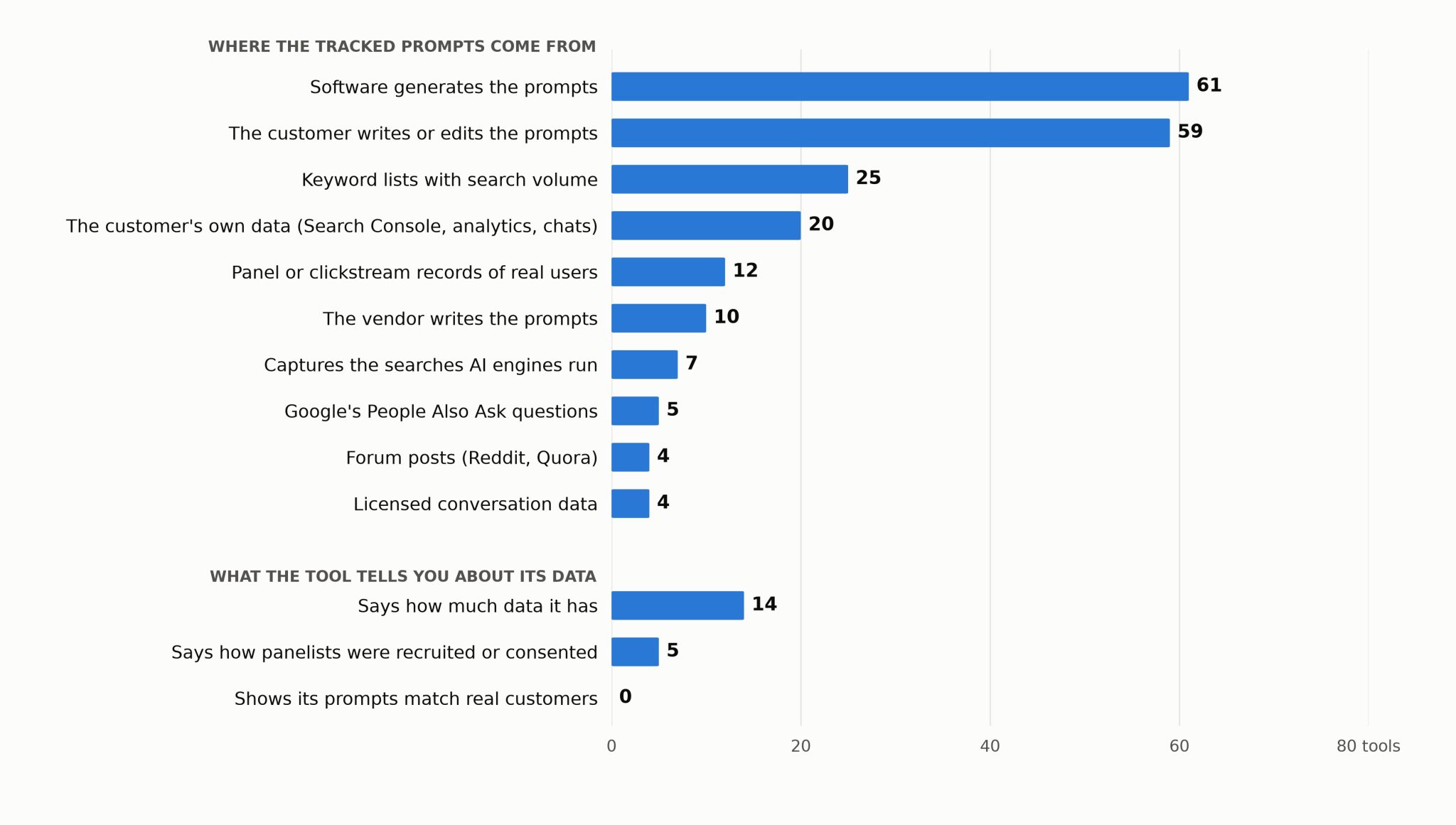
First, here is the zoomed-out chart, followed by a second chart with the details.
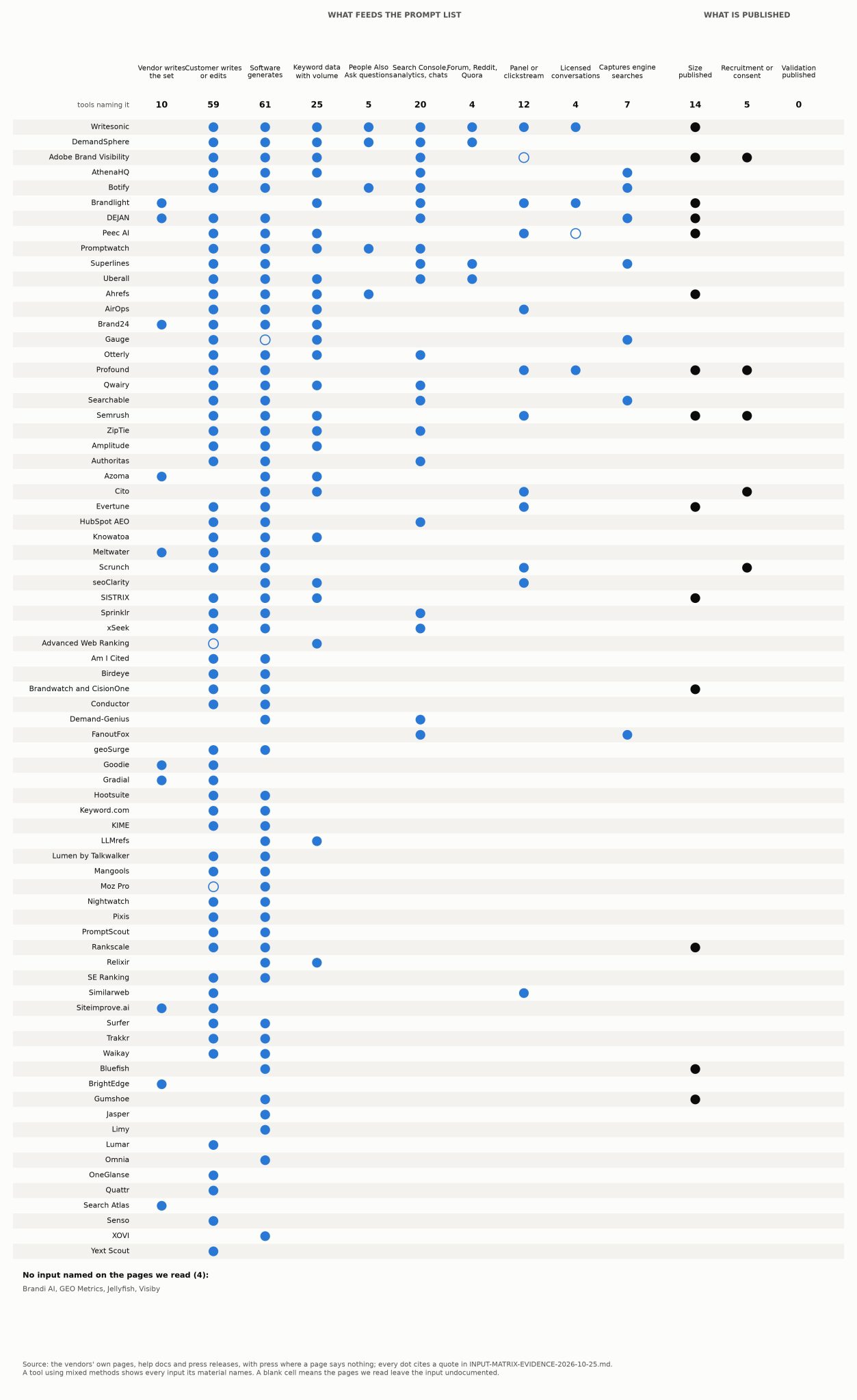
The next chart sorts the 79 tools that track prompts – at least to some degree – by where their prompts come from. A hollow blue circle means the input is attributed to the tool by a source other than the vendor: a review site, trade press or a search summary surfaced it, but the vendor’s own page does not. Filled circles indicate data is derived from the vendor’s own page.
Now The Geeky Stuff
Seven of 87 tools studied overall don’t use prompts, measuring the aftermath, impressions, referrals, and crawler hits. These seven belong to a different conversation. One more, Muck Rack, tracks prompts but blocks automated reading of its site and help center, so it sits outside the charts and we describe it only from its own press release. Two of them, the AI Performance report in Bing Webmaster Tools and Google’s Search Console AI report, come from the engines themselves. While they don’t track prompts and aren’t included in the charts, we believe Bing’s, in particular, is among the most valuable sources a site owner has, while Google’s shows far less. We’ll cover both later.
For four of the remaining 79 in the table above, we couldn’t find published prompt creation methods, so the chart shows them as blank rows.
Eleven of the tools run on a human-curated prompt list. Some vendors supply the set, as BrightEdge does when it “builds and tracks those prompts for you.” In other tools the customer provides the list, as at Quattr, Lumar and Senso. Two of the eleven, Siteimprove and Gradial, start from a vendor-suggested set or template the customer edits. Lumen by Talkwalker (formerly Talkwalker) and Hootsuite, which share an engine, offer a list of prompts that software generates from the brand’s goals. We count them with the software-generated tools, because our rule is simple: when software drafts the list and a person only approves it, the software is the source.
Forty-seven tools state (or their pages imply) that software generates prompts, working from a keyword list, a URL, a persona, or a brand name, as at Otterly, HubSpot, and Gumshoe. DEJAN, a marketer we completely respect, monitors what it calls “canonical core intent entities” with one fixed prompt per entity, and tells us it integrates Search Console data with LLM-generated entities, queries and prompts, all mapped back to those entities. Peec’s suggestion engine works from your website, industry and existing topics, and its discovery setup starts from what you sell and your buyer personas. A human reviews the suggestions, and brands can also enter prompts by hand or upload a file. In all of the 47, software writes some or all of the prompts from inputs it was fed, and none of that same group shows that the prompts it generates match what real people ask LLMs, even where a brand adds questions it knows are real.
What is Prompt Volume in AI Visibility?
Demand data (where there is any) is usually rooted in keyword seeds. Otterly, Gauge, and LLMrefs start from a keyword list, and LLMrefs shows search volume beside it. Peec folds live search trends into its score. A model then synthesizes prompts from search-backed seeds, but none of these vendors prove that the prompts match the words real customers use or how often they ask, which is the language and scale of the question space.
We’ve studied where keywords appear, and how far left or right they sit, both in LLM outputs and in fan-out searches models run behind the scenes. In our opinion, imputing how often people ask LLMs about a core concept is reasonable, but using search volume to assign a frequency to one specific prompt only works when you zoom out to cohorts that are big enough, well above the level of a low-data Boolean vertical.
Where a volume figure is assigned to the prompt itself, Peec models it from the search seed and from conversation data whose source its pages leave unnamed, clickstream or otherwise, though TechCrunch reported in November 2025 that Peec had “bought raw datasets of these requests.” Trakkr’s docs show an “Estimated monthly AI demand” without disclosing how the figure is built, which leaves a buyer taking either number on faith. Lily Ray published a Google Sheets formula in June 2026 that rewrites a keyword as the question a person might put to an assistant, with her own caveat that no prompt selection is perfect; the vendors in this class sell a similar rewrite style at scale with a volume figure attached.
Eight vendors cite panel or clickstream data, meaning records of what some group of tracked users did online, gathered through software those users installed or through a license the vendor acquired. These specific vendors are Profound, Semrush, Adobe Brand Visibility through Semrush, Similarweb, seoClarity, Scrunch, Evertune and Brandlight.
Panel data is one ingredient among several. Seven of the eight also let customers write their own prompts, have software generate them, or both. Brandlight says of its prompt set, “We build it, you don’t,” drawing on “hundreds of millions of real prompts observed through licensed consumer panels, clickstream and purchase data, search demand, your own Search Console and site search, and your business priorities.” Profound lets customers upload their own prompts, write custom ones, or use what it calls “auto-generated prompts built from real AI Search data.” Semrush lets customers enter prompts by hand, import them, or “use the prompt suggestions feature,” and adds what it calls “Google’s keyword dataset,” which appears to be Semrush’s own database of Google keywords rather than data from Google. Adobe Brand Visibility adds prompt suggestions drawn from the customer’s Search Console data and a queue of “suggested prompts and topics.” Scrunch takes up to 500 prompts pasted at once or will “create prompts based on your brand configuration and selected personas,” beside its consented panels and its own automated response collection. Evertune lets customers “upload up to 250 custom prompts,” and its onboarding guide says its “Prompt Agent generates suggested topics and prompts” from its panel data. seoClarity offers to “generate relevant prompts” beside search intelligence and topical clusters, and Similarweb, which “owns its data panel, providing a stable foundation built on real user behavior,” lets customers add custom prompts while combining its global panel with public data and direct measurement.
That leaves nine tools. Five build their prompts from Google keyword or question data: Ahrefs, SISTRIX, Promptwatch, Writesonic and DemandSphere, with Writesonic also drawing on actual chat data. Three build from the customer’s own first-party data: Botify from the customer’s own data, Qwairy from Search Console queries, and Sprinklr from real customer conversations, as Sprinklr’s own page describes it, though its help center says the platform “automatically creates prompts for your review” from those signals and takes custom prompts too. The last one, FanoutFox, captures the searches ChatGPT itself runs behind a prompt, inside the user’s own session.
Add the first three groups together and 62 of the 79 tools appear to run on prompts that a person wrote, a model generated, or nobody explains. On the pages we read, none of the 62 publishes a check showing that those prompts reflect how a brand’s actual customers ask in LLMs.
Disclosure Levels About Prompt Sourcing
Vendors who disclose how their prompts are derived deserve credit for doing so in public. Ahrefs reported in September 2026 that its Brand Radar prompt set “has grown from around 14 million to 30 million prompts,” a figure the English post gives without saying what it counts, while the Spanish edition states it as “30 millones de prompts por plataforma” (30 million per platform), and the same post explains the origin: “The source is the same (Google’s “People Also Ask”), but a lower search volume threshold now pulls in more questions.” For each prompt, the post explains, Ahrefs “finds the parent keyword, takes its Google volume, and multiplies by that platform’s estimated usage ratio.”
Semrush became an Adobe company when Adobe completed its acquisition of the brand on April 28, 2026. Semrush writes that it starts “by sourcing billions of real prompts from AI search clickstream data and Google’s keyword dataset for AI Overviews.” Its April 7, 2026, study refers to “Semrush’s 200M user clickstream panel” and credits the panel with showing “The language of each specific ChatGPT prompt in the sample.”
We scrutinized Semrush, and beyond a June 17, 2026 announcement describing its prompt data as being “built on consent-based data collection,” we can’t find an explanation of how those 200 million users were recruited or what they agreed to. The same study reports that, “For most of the study period, between 65% and 85% of prompts couldn’t be matched to any traditional search keyword in Semrush’s database,” which is one of the more useful figures any vendor has published on how far keyword lists can stand in for prompts.
Profound, which raised “a $180 million Series D at a $1.8 billion valuation” on September 15, 2026, and counts “2B+ real user prompts” in the same post, publishes the most about its panels of any vendor we read. The company “licenses conversations from multiple, double-opt-in consumer panels of real answer engine users,” puts the scale at “hundreds of millions of prompts per month from millions of active users,” and extrapolates from the dataset with what it calls “probabilistic modeling.” Profound adds that its insights rest on “real data from double opt-in consumer panels, not API outputs or synthetic estimates.”
The rest of the panel class publishes less. Similarweb describes its prompt data as “aggregated from real AI searches” and cites “real user data” with no panel size on the page. seoClarity writes that its prompt research uses “search intelligence, topical clusters, and proprietary clickstream data.” Scrunch, which Sitecore acquired in June 2026, lists “High-quality, consented consumer panels” among its methods, beside its own automated response collection, with no panelist count and no mechanism, and calls its volume “directional.” Evertune prints two sizes on two pages, “real-world usage data from 25 million internet users” on one page, and “EverPanel, our panel of over 150 million real conversations, weighted to reflect the actual composition of the internet” on the other, with no recruitment or consent text on either. Its September 2026 release repeats the 150 million figure, and the copy we read is hosted on Yahoo Finance. Adobe’s partner FAQ credits the GEO intelligence layer of Adobe Brand Visibility (formerly LLM Optimizer) to Semrush AIO, with “213 million prompts tracked,” and Semrush’s June 17, 2026 launch release puts the figure at “nearly 300 million real-world AI search prompts.” Adobe’s announcement of Brand Visibility prints “261 million real AI search prompts,” so three Adobe-side figures are in print at once; the FAQ gives neither a panel size nor a recruitment method.
Not one of the eight panel vendors publishes an exact panelist count together with how those people were recruited or on what platform permissions were granted. Semrush describes its clickstream panel as built with “hundreds of clickstream data providers.” Its president told Digiday in December 2025, “We calculate volume essentially by normalizing the panel.” Adobe credits the data layer of Adobe Brand Visibility to Semrush, and the pages of the other six leave any outside panel provider unnamed. Evertune’s weighting to “the actual composition of the internet” and Profound’s statistical modeling that “corrects for demographic and geographic biases” are the only statements of weighting to the population in the eight vendors’ pages, and neither says what population or benchmark it weights to. Brandlight calls its panels “representative” without saying of whom.
A brand considering one of these platforms appears to have no published means of checking whether these panelists ask the way its actual customers ask, which is highly specific to Boolean verticality.
SISTRIX describes its prompt research as drawing on “over 62 million real user questions from Google Search and further sources,” and the same page, dated August 14, 2026, says its AI volume estimates are “based on real usage data from AI platforms,” with neither the further sources nor the provider of the usage data named. We placed SISTRIX with the keyword and People Also Ask group on the strength of its Google Search questions, but it was a close call. Peec AI writes that its “suggestion engine creates prompts based on your website, industry context, and existing topics.” A post Peec published on September 29, 2026 called tracked prompts “only a sample of all the questions asked by your customers every day.” Peec also publishes how far its numbers move, on a monthly average at 95 percent confidence: about plus or minus 6.1 points with 50 prompts run once a day, and plus or minus 13.2 points with 10 prompts run five times a day. Of everything we read on sampling, Peec’s post strikes us as the most candid.
Several social listening and PR suites split prompt composition between the customer and software. Meltwater offers “prompt-level customization, allowing you to simulate real buyer journeys,” and Lumen by Talkwalker tells buyers they can “Create custom prompts or auto-generate a list in seconds based on your goals.” Cision, “powered by data from Trajaan,” a search intelligence company Cision bought in December 2025, covers “thousands of prompts worldwide,” and its help center wrote on September 18, 2026 that “The AI auto-generates up to 200 relevant prompts that simulate real user queries,” alongside “prompts you define.” Sprinklr’s own page reads, “Sprinklr exclusively builds prompts using real customer conversations across social, care, search communities, & reviews,” which matches its June 10, 2026 newsroom release. Its help center adds that “Prompts are generated using real signals from social listening and news, combined with how AI tools interpret and respond to the selected inputs,” 50 of them by default, and that customers can import prompts or “click + Custom Prompts to add more.”
Bing has historically treated webmasters with more respect and more transparency than Google. Its AI Performance report in Bing Webmaster Tools appears to show site owners what happened after the prompt, and leaves the prompt itself out. Search Engine Journal reports that Bing Webmaster Tools now shows “grounding queries,” and Microsoft’s post of February 10, 2026, stated the report “Shows the key phrases the AI used when retrieving content that was referenced in AI-generated answers,” that “The data shown represents a sample of overall citation activity,” and that it covers Copilot, AI summaries in Bing and unnamed partner integrations.
Since then, Microsoft has added intents, topic clusters, a Citation Share it calls “an observational metric” (June 16, 2026), and a Topics Portfolio beta that lists the grounding queries where other sites are cited and yours is not (October 13, 2026). All of this still at the grounding layer, one step after whatever the person typed. Microsoft’s June 16 and October 13 posts carry the detail; Aleyda Solís and Barry Schwartz covered the June release the day it shipped, and Schwartz’s point holds for both engines: still no click or click-through data.
Google’s Search Central post on the Search Console AI report reads, “As of August 31, 2026, we’ve rolled out these insights to all websites worldwide,” and the fields it lists are impressions, pages, countries, devices and dates, with no query field. As Barry Adams noted the day it launched, no clicks. The ordinary performance report is another matter: Suganthan Mohanadasan showed in August that AI Mode follow-ups land there as queries, “yes go on” among them, which John Mueller confirmed, alongside what Mohanadasan identifies as scheduled probes from AI visibility tools. So Google shows no prompts in the report it built for AI, yet fragments of them leak into its ordinary performance report, which was never designed to show them. Eli Schwartz read the launch as a market signal, writing, “The lack of visibility into how sites are showing up in AI is a significant driver of the growth of AI visibility tools that manufacture data.”
Missing Validation Studies
We looked among vendors, academics, and critics for a published validation of any tool’s prompt set against what people are proven to have actually typed into an AI assistant. We couldn’t find any. Peec did measure how noisy small prompt samples are, and Petra Labs measured how much ChatGPT and Gemini search answers vary from run to run. Each study answers a narrower question than whether a prompt set matches what customers actually ask.
For the eight tools that draw on panel or clickstream data, the open question remains whether the panelists resemble your customers once you narrow down to the Boolean vertical you actually sell into. Kevin Indig made the sampling point in June 2026, writing that prompt tracking “will look less like rank tracking and more like polling,” with prompts run many times, confidence intervals, and each platform measured separately. Peec’s plus or minus figures, monthly averages at 95 percent confidence, are the one vendor example of that discipline we found in print.
Panels, Clickstream, and Scale
Earlier I promised more on panels and clickstream. I spent months inside clickstream records, stripped of PII, so the arithmetic below is familiar ground. To my mind, it’s where the splashy vendor pitches run out of data. To some, the quantity of panels’ sampling sounds enormous. Seriously, it is arguably a drop in the ocean, because the paradigm is one of intense and ever-growing verticality.
Vendors promote their SIZE loudly, with numbers that sound huge, so here they are in the vendors’ own words. Semrush names “Semrush’s 200M user clickstream panel.” Profound describes “hundreds of millions of prompts per month from millions of active users.” Evertune prints “25 million internet users” on one page and “over 150 million real conversations” on another. Each figure describes scale, but scale alone leaves open whether a panel resembles a buyer’s true customers. Verticality math shows how fast that scale disappears. Here’s how:
The raw volume is enormous. Google reported in March 2025, as the trade press cited, that it sees over 5 trillion searches annually; a paper by OpenAI and Harvard researchers, published through NBER, cited 18 billion ChatGPT messages per week by July 2025; and OpenAI told Axios in July 2025 that about 330 million of its 2.5 billion daily prompts come from the United States. Profound describes “hundreds of millions of prompts per month.”
At OpenAI’s reported 2.5 billion a day, ChatGPT alone handled about 75 billion prompts per month in July 2025. A 300-million-prompt panel, one example inside Profound’s range, would equal roughly 0.4% of ChatGPT’s monthly volume. The panel’s real share of all AI prompts is smaller than 0.4%, because the 75 billion figure leaves out prompts on Gemini, Perplexity and Copilot. ChatGPT’s own volume has likely grown since July 2025, with weekly users reaching 1.2 billion by September 2026.
Semrush, for its part, reports over 1 billion clickstream lines across 17 months, October 2024 through February 2026, without publishing the monthly average or how many lines carry prompt text. The questions keep changing too: by Mueller’s figure, about 15% of the searches Google sees each day are brand new, and prompts likely change even faster. Keyword counts work because people type the same keywords often enough to measure, but Semrush’s April 2026 study found that, for most of its study period, 65% to 85% of prompts in its sample matched no traditional search keyword in its database, so counting keywords can’t tell you how often people ask a given prompt.
Now apply Boolean verticalization, because a vertical is category AND role AND place AND window AND external factors (the economy, new concepts, acts of G_d), and every “AND” operator in sequence divides the already-tiny sample.
Start from those 300 million prompts per month, and assume, generously, that 0.05% land in a broad consumer category, 10% of those come from the role you sell to, 13.2% come from the United States on OpenAI’s reported share of prompts, and 2% of those from one mid-sized state. Treating each share as independent of the others is itself an assumption, since buyers in one role may cluster in some states more than others. Over five weeks, that narrow panel slice would hold ~46 prompts. If a tool reported that your brand appears in half of those answers, the real figure could fall anywhere from about 36% to 64%, and that wide range holds only if the panel’s users resemble your market, which no vendor has shown.
Run the same arithmetic on a niche B2B category at 0.0005%, and over five weeks that slice holds about half of one prompt. You can’t measure half a prompt, so any number a dashboard shows you for that slice is a model filling the gap, which is what Profound calls “probabilistic modeling” and Scrunch calls “directional.” In plain terms, you may be paying for an estimate of questions the panel probably never saw.
Yikes!
There’s a second problem, separate from the shrinking numbers: whether your actual customers are in the panel at all. A panel records who typed a question, but nothing in it shows which of those people ever bought from you.
Here’s how that plays out with a panel of 5 million users, 40% of them in the United States, which is 2 million US panelists out of an assumed 260 million eligible US users, or about 1 in 130. If your brand has 20,000 US customers, about 154 of them would land in the panel by chance. If 2% of those 154 typed a prompt about your category in a given month, you would expect about three, and nothing would mark which three are actually customers of yours. If the panel’s US share instead matched ChatGPT’s reported 13.2% of prompts, that drops to about one prompt per month.
Real life then adds more filters. A storm or a new product line narrows a slice that was already close to zero, and a prompt set built before the event may contain nothing about it at all.
A panel of 200 million users may describe how the market asks. It cannot tell me how my customers ask, because 0 of the 8 panel vendors publish an exact panelist count beside the recruitment method, and none label which prompts, if any, came from people who buy from me. Only 4 of the 8 mention consent at all (Profound, Scrunch, Semrush, and Adobe through Semrush’s June 17, 2026 statement), and only Profound names a mechanism, double opt-in.
Three questions people keep asking me
Is clickstream data made of actual prompts?
It can be, when the panel captures text, as Semrush says its panel does and as Profound’s licensed conversations suggest. We think the harder question is whether the panelists ask the way your actual customers ask, and none of the eight panel vendors publishes enough about its panelists for brands to check.
Is Bing’s report made of actual prompts?
Bing reports grounding queries, which Microsoft describes as “the key phrases the AI used when retrieving content that was referenced in AI-generated answers,” so they are phrases Bing’s system issued to retrieve pages, one step removed from whatever the user typed. Bing’s report is the only first-party feed of engine-issued searches offered to site owners that we came across, and in my view, it is worth watching, sample or no.
Does Bing show what ChatGPT searches?
Microsoft and OpenAI have been partners since July 2019, when OpenAI announced that “Microsoft invests in and partners with OpenAI.” We’ll leave the terms of their relationship to the two companies. In anything we read, neither company has explained whether Bing’s grounding queries match the searches ChatGPT runs today. Bing’s report shows Bing’s retrieval phrases, and any claim about ChatGPT’s searches would need its own study.
What to ask your vendor
Buyers are entitled to clear, written answers to four questions before signing, and I would ask them in the order below.
- Where exactly do the prompts come from: who wrote them, or, for a panel, how many people are in it, how were they recruited, did they agree to their words being used, who stripped the personal details, and which company runs it?
- How many prompts are in the set, who chose them, and how often does the set change?
- Has anyone checked the prompt set against what real people type into an AI assistant, and if so, who did the check, when, and with what result?
- Can you prove to me that your prompt imputation is accurate for the verticality of MY brand?
If the answers come back as “we do not say,” “none,” “It’s proprietary” or “no,” the number on your dashboard may hinge on some list nobody can trace to reality.
Our Take
Knowatoa, Otterly, Peec and Ahrefs already give clear explanations for any brand to buy into, or not. This is not an endorsement.
Our opinion, after reading all 79: you are buying a list, and dashboards include measurements based on that list. The panel and data vendors among the list owners sell products built on their data, and that is their business…big business at that.
Until any vendor explicitly publishes a validated check of its prompts against what real people type, no visibility score deserves to be called a true measurement of how customers ask. The most honest vendors already say that straight up; the rest should be asked why they do not.
Run the same selected prompts every day and you can measure how AI systems respond to them every day, which is genuinely useful, and so is tracking citations, mentions and changes over time. Sell that utility, explain the assumptions and charge whatever the market will bear.
But when you claim to measure how MY customers ask, publish the evidence, and until then call the results what they are: modeled estimates of visibility against selected prompts.
Appendix: vet your AI visibility vendor, all 79 sorted by where the prompts come from
This section repeats the findings above in more detail.
Here is the roster, grouped by what each company publishes or we tracked down, so you can clarify what you’re paying for. Each tool is placed by the main source of its tracked prompts as the vendor’s own page describes it, except the five keyword tools, which we placed by the Google data behind their prompts and volume figures, and the eight panel tools, which we placed by the panel data behind their suggestions and volume figures; where a tool mixes sources, its entry names the mix. We read the roster as the evidence behind the opinion above. Six of the seven groups that track prompts are selling you a list; FanoutFox captures your own session instead, and no group’s list comes with a published check against what your brand’s customers prompt in the wild.
No complete prompt source on pages we could find (4):
Visiby, Jellyfish, Brandi AI, GEO Metrics. Anyone buying one of these 4 tools may have a hard time finding a prompt source to audit. On the pages we read, buyers could not audit which tracked prompts people typed and which were synthetic.
The vendor or the customer chooses the tracked prompts (11): BrightEdge, OneGlanse, Siteimprove.ai, Yext Scout, Lumar, Search Atlas, Advanced Web Ranking, Quattr, Gradial, Goodie, Senso. Goodie recommends a starting set during onboarding that customers can “select, adjust, or swap,” and Senso, which agreed in October 2026 to be acquired by Zeta Global, lets customers add their own prompts. In this group one party chose the list, and the buyer sees no data on which prompts made the cut or how often anyone types them. A customer-written set may draw on Search Console queries. A vendor-written set lets the vendor choose the questions it grades itself on.
Software writes them, or drafts them for a person to approve, from a brand, a URL, a persona or a keyword list (47): Peec AI, HubSpot AEO, Otterly, AthenaHQ, Rankscale, Nightwatch, ZipTie, Gauge, LLMrefs, Knowatoa, Trakkr, Gumshoe, SE Ranking, Mangools, Relixir, Conductor, Pixis, Waikay, xSeek, Bluefish, Surfer, Amplitude, Azoma, Searchable (which bought Meridian Tech in September 2026), PromptScout, Authoritas, Meltwater, Lumen by Talkwalker, Hootsuite, Brandwatch (with CisionOne), Uberall, Brand24, Limy, Demand-Genius, Superlines, XOVI (whose product is now named Riva), geoSurge (whose October 20, 2026 release says its app “drafts the questions buyers are likely to ask”), DEJAN (whose post, titled “Why we don’t do prompt tracking,” says of its fixed prompts, “The wording never changes between runs”), AirOps (whose docs say it “generates tracked prompts” from SEO keywords and “Panel data that reflects AI search behavior and trends,” with no panel provider, size or consent text), Cito (whose pricing page offers “Realistic prompt recommendations using proprietary AI chatbot dataset” without saying where the dataset comes from, and which builds its volume figures from “consented panel data on AI prompt usage,” Google Search Console and Ahrefs), Omnia (whose Topic Explorer “automatically surfaces high-value prompts”), Am I Cited, Birdeye, KIME, Keyword.com and Jasper (whose GEO page offers a Query Planner to “Generate and prioritize the AI search queries your brand should be targeting”) and Moz Pro (whose help center says to build a prompt list you can “Enter a topic manually and click Generate” or “Manually add prompts”).
Eleven of the 47 also take in first-party data: Otterly and AthenaHQ convert Search Console queries into prompts, ZipTie imports them, xSeek takes prompts “from your site, your audiences and, if you connect it, your Google Search Console queries,” HubSpot AEO’s recommendations are “powered by your CRM data,” Uberall pulls candidate prompts partly from Search Console, Reddit and YouTube, Demand-Genius draws on buyer journey and engagement data, Authoritas offers a free tool that turns up to 1,000 Search Console queries into prompts, DEJAN tells us it integrates Search Console data, and Searchable says its optional Search Console link “helps you generate better prompts by showing what keywords you already rank for.” Superlines lets customers add prompts or “let Superlines auto-discover them,” and lists a “Google Search Console integration for prompt discovery” with “Reddit and Quora prompt discovery” among its sources. Knowatoa puts it bluntly: “Nobody has the data on what buyers are typing into ChatGPT.” Otterly’s help page reads, “No, AI search engines do not publish query data,” and then names three methods, a prompt research tool, Search Console queries converted into prompts, and prompts brainstormed with ChatGPT, which it calls “the best available substitutes.” The page gives no basis for the label beyond the engines publishing no query data, and in my reading the label runs ahead of anything the page shows. Rankscale describes its volume figure as “estimating how often a given intent exists within the model’s learned distribution,” which in plain terms likely means prompting a language model to output an estimate drawn from the text it was trained on. However fluent the output, a model’s paraphrase of a keyword is something software wrote, not something a customer typed.
Panel or clickstream data (8): Profound, Semrush, Adobe Brand Visibility (formerly LLM Optimizer), Similarweb, seoClarity, Scrunch, Evertune, Brandlight. Seven of the eight also take customer-written or software-generated prompts, as the panel section above describes, and Brandlight builds the set itself. Brandlight, in its February 11, 2026 release on PR Newswire, describes its platform as “analyzing billions of AI-generated signals across the customer journey,” a figure the release leaves undefined. Scrunch writes: “No AI platform provides a native, first-party prompt feed today.” Representativeness is the familiar worry with any panel of tracked users.
In twenty-five years of reading search data, I’ve never met anyone outside Semrush who could check its keyword data, and the industry drinks it like Kool-Aid anyway. Consent is the newer worry, and we suggest buyers can ask about it directly: did the people whose words are being sold know their prompts would be used, who stripped the names, dates and personal details out of the text, and who held the raw text before the stripping? As mentioned, Profound says double opt-in and that its prompt data is “anonymized, aggregated, and scrubbed of PII.” Scrunch says “consented,” and Semrush’s June 17, 2026 announcement, which Adobe inherits, calls its prompt data “built on consent-based data collection,” with no mechanism named.
Dan Petrovic of DEJAN put the objection in writing on October 4, 2026, calling clickstream “Unethical, creepy and bundled with a looooooot of mathematical fudge.” Hidden prompt capture is one route for gathering prompt text. Koi Security reported in December 2025 that a family of VPN browser extensions with about 8 million installs captured prompts and responses on eight AI sites and sent them to an affiliate of a data broker. That report is secondhand, and nothing we read indicates that any AI visibility vendor bought the data.
Google keyword data or People Also Ask (5): Ahrefs, SISTRIX, Promptwatch, Writesonic, DemandSphere. All five also let software draft prompts from those seeds, and customers can add their own. Promptwatch “derives a tracked prompt’s volume from the keywords attached to it,” weighting AI search five times, Bing 1.5 times and Google 0.5 times, and its glossary says prompt volume “is modeled, not measured.” DemandSphere writes, “You are not going to find a more grounded source for anything related to topic volume than Google Search Volume.” Writesonic says its candidate prompts “are sourced from Google Keyword Planner, Reddit threads, People Also Ask results, and actual chat data,” and the same post cites “the 2B+ real-chat dataset” and “real AI conversations from clickstream data,” which could arguably place Writesonic with the panels. Search data is the largest record of what people want that I know of, and for four of the five a search question stands in for a prompt, a substitution we found no one has tested in public, while Writesonic also draws on actual chat data. Semrush’s study found that, for most of its study period, 65 to 85 percent of prompts in its sample didn’t match a traditional search keyword in its database, with the matched share rising from 18.9 to 34.9 percent between October 2025 and February 2026, and Ahrefs’ methodology page says of weighting mentions by Google search volume, “This is a modeling choice, not a measured relationship.”
A first-party feed (3): Botify, Sprinklr, Qwairy. Botify offers to “Track prompts grounded in your data and real customer behavior,” and Qwairy lets customers “Import real search queries and discover AI monitoring prompts” from Google Search Console. Sprinklr’s own page says it “exclusively builds prompts using real customer conversations across social, care, search communities, & reviews.” All three also have software write prompts, Botify and Qwairy from the Search Console seed and Sprinklr from its social and news signals, and Qwairy describes a generator that “automatically discovers and generates relevant prompts.” These feeds hold searches that already surfaced the site or conversations already tied to the brand, so they may lean toward later-stage research and miss the questions of people the brand has yet to reach.
Captures the engine’s own searches (1): FanoutFox “reads your own ChatGPT sessions,” says “nothing leaves your browser,” and covers ChatGPT only, since its FAQ says Perplexity capture was retired in version 2.0.0. The cloro.dev API returns “parsed sources, citations, query fan-out, and shopping blocks” across ChatGPT, Gemini, Perplexity, Copilot and Google’s AI Overviews and AI Mode for prompts the operator sends, so both routes stop at prompts the operator supplies or captures and show nothing of what anyone else asked.
Blocks automated reading (1): Muck Rack. Its site, product page and help center refused our crawler on both days we tried, so we could not check how its tracked prompts are built. Muck Rack’s September 10, 2026 release says Generative Pulse “uses millions of real AI interactions to surface the questions people are actually asking,” spanning “consumer interactions with platforms including ChatGPT, Gemini and Google AI”, and the release names no provider, panel size, recruitment or consent.
Track no prompts, and so sit outside the 79 (7): Google’s Search Console AI report, the GA4 AI assistant channel, Bing Webmaster Tools, the Google Ads AI Max report, Adobe Analytics and CJA, Matomo and Cloudflare AI Crawl Control. Cloudflare also sells a separate tool that does track prompts, the AEO Visibility Dashboard, in early access since August 6, 2026; it probes assistants with what PPC Land calls “likely prompts” built from a site’s industry and category, and it surfaced after our roster closed, so it sits outside the 87.
Methodology
We conducted this study between October 22 and 25. On October 27 we re-read every tool’s own prompt-setup documentation and altered 28 rows; the counts and charts above reflect that re-audit, and one tool whose site blocks automated reading sits outside the charts. We were unwilling to let any one model grade its own output, so we ran four separate and lengthy passes. Claude Fable, orchestrating Opus, Sonnet and Haiku subagents, crawled vendor page by vendor page and tested every sentence against its source. We fired one Google News search per tool, 81 in all, and combed the 597 articles that came back for anything newer than what the vendors’ own pages said. We had OpenAI’s models run a separate evidence pass and re-grade the findings, and we applied the changes that pass returned. Next, we dialed in Gemini with search grounding to re-grade all 80 tools and every factual sentence across 629 searches. Every disputed claim was settled against the source page itself rather than against another model’s opinion, and I made open judgment calls. There were a handful of pages that locked out bots, so we opened them in my browser and read them there.
If you are a platform reading this post and take issue with any of our findings, please provide us data and we’ll amend this article.